
Inside Marion County Tax Records
Valuation and collection work is split between two Marion County offices. The Appraiser maintains the value side. The Treasurer handles the money side. On the parcel card you get annual land, building, and total appraised values, while the tax detail adds the assessed amount, levy, ad valorem tax, special assessments, total paid, delinquency flag, tax unit, and transfer clues.
| Field | What It Shows | Where |
|---|---|---|
| Appraised value | Annual land, building, and total estimates | Appraiser parcel card |
| Assessed value | Class-adjusted amount used in the tax formula | Treasurer tax detail |
| Mill levy | Combined levy applied for that parcel and year | Treasurer tax detail |
| Specials | Separate special-assessment amount | Treasurer tax detail |
| Payment status | Total, paid amount, and delinquency flag | Treasurer tax detail |
Kansas appraises most real property at fair market value first. A statutory class percentage converts it to assessed value. Homes are assessed at 11.5 percent. Vacant lots sit at 12. Commercial and industrial property sits at 25, and agricultural land at 30 percent of use value. The levy and specials come after, yet none of these figures is a sale price.
Open a Marion County Tax Bill
The official Marion County tax search offers several ways in. You can enter Last Name or Company Name. Tax ID, tax year, address number, two direction fields, street, and ZIP are also options. The year dropdown covers 2025 back through 1987. When an address is ambiguous, start with the parcel card. Match the legal description and tax ID before trusting a bill.
| Search field | Input | Use |
|---|---|---|
| Last Name / Company Name | Text | Find bills under an indexed taxpayer name |
| Tax ID | Text | Open the tax account when its key is known |
| Tax Year | Dropdown, 2025 through 1987 inspected | Keep results tied to one levy year |
| Address | Number, prefix direction, second direction, street, ZIP | Resolve the taxable situs with its directional parts |
The official tax search screen displays those owner, year, tax-key, and address controls together.
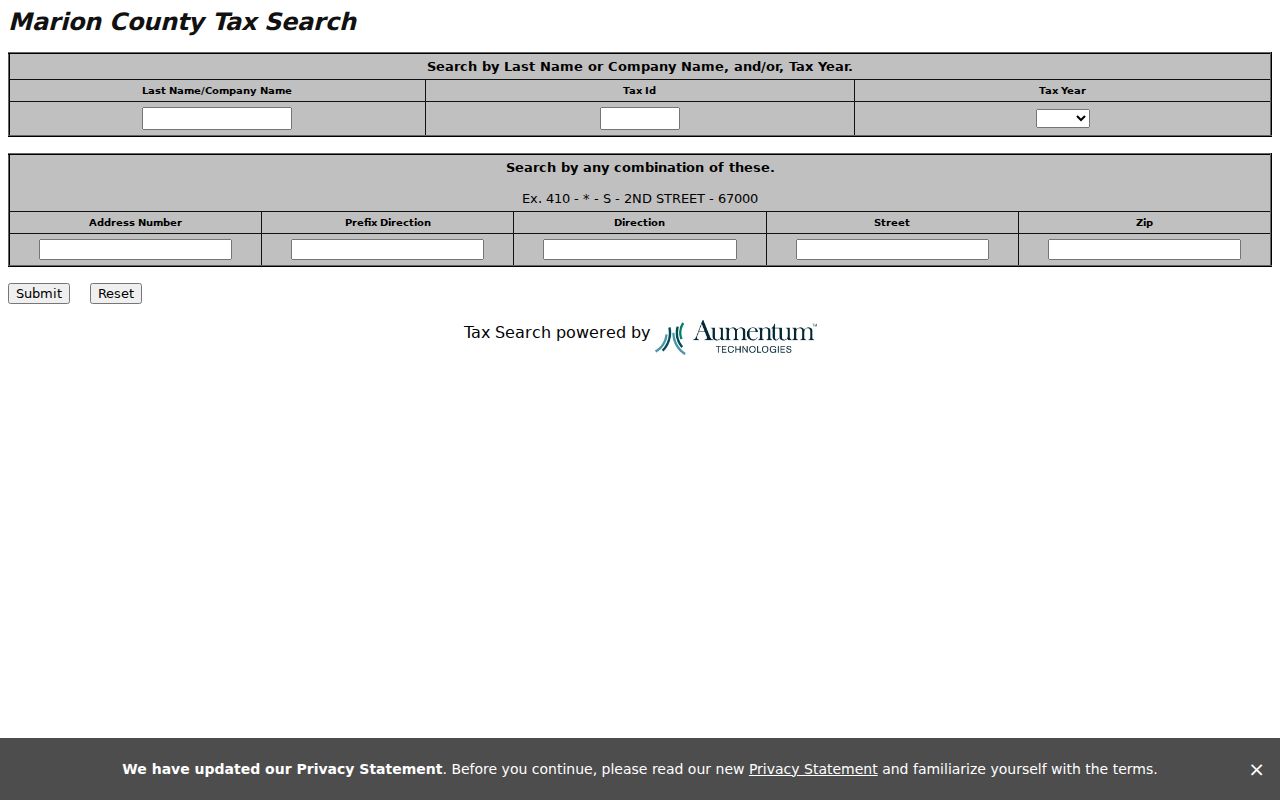
The official search page allows combining or separating the keys. A narrow query is easier to audit than a broad name-only result.
- Search by owner or address and open View Tax Information for the correct land.
- Confirm the tax ID, parcel/CAMA key, situs, legal description, tax unit, and transfer reference.
- Read assessed value, mill levy, ad valorem, specials, total, paid amount, and delinquent flag for one year.
- Expand prior years to distinguish a one-year change from a longer value or levy trend.
- Contact the Treasurer when a payment, purchase, or pending foreclosure status is unclear.
- Assessed value
- The class-adjusted value used in the tax calculation.
- Mill levy
- The tax rate expressed in mills and applied to assessed value.
- Homestead relief
- A Kansas tax-relief concept with eligibility that must be checked through the current state and county process.
- Special assessment
- A separate charge tied to a public improvement or other authorized cost.
- Tax lien
- The government's claim securing unpaid property tax.
Read Marion County Tax History
The inspected detail for 210 N Cedar displayed years 2021 through 2025, including assessed value, levy, ad valorem, specials, total tax, paid amount, and delinquency. In 2025 it showed assessed value of $14,747 and a total bill of $2,992.96, while the parcel card showed a different appraised-value layer. These figures are not contradictory.
The official sample tax detail is pictured below. Its year rows help separate value movement, levy movement, and special charges.
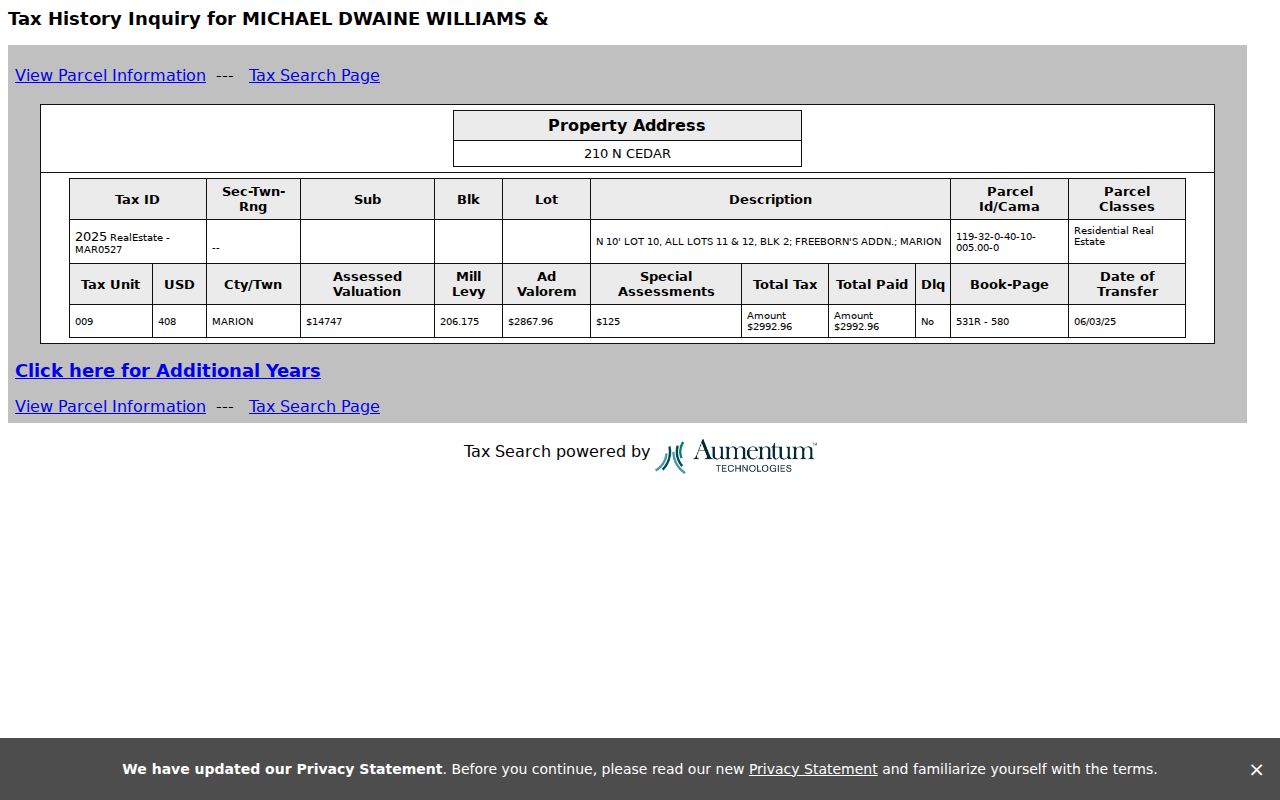
The tax screen also carried an owner heading that did not match the parcel card. Match the recorded deed before trusting a tax header.
Marion County Tax Due Dates
First-half real-estate tax in Marion County is due December 20, and the second half is due May 10. Unpaid real estate accrues interest. The tax roll is set September 1, and statements go out after certification around the first week of November. Anyone buying after the roll date should contact the Treasurer for the correct statement.
The Treasurer's office sits at 200 S Third Street, Suite 102, Marion, KS 66861, and the phone number is 620-382-2180. Hours run 8 a.m. to 5 p.m. on Monday, Wednesday, Thursday, and Friday, with a 9 a.m. opening on Tuesday.
Keep the tax year attached to every amount. A payment posted to one year does not settle another, and a current paid status does not rule out a separate special assessment, lien, or court case. When a sale closes near the roll date, compare the statement issued to the prior owner against the parcel and deed records before deciding who should receive a notice.
Marion County Delinquent Tax Trail
A delinquent flag marks one point in a longer process. The county's current Tax Sale page lists property with unpaid 2021 and older taxes. Those parcels are eligible for judicial tax foreclosure. A published list can shift after payment, dismissal, or court action. Verify the Treasurer entry and the District Court case.
The 2026 sale sheet warns buyers to research the legal description. It also covers zoning, special assessments, appraised value, easements, and covenants. Maps, addresses, and photos are not warranted. The legal description controls. Ownership also stays with the current owner until court confirmation.
Work the trail in order. Start with Treasurer history and the official sale list. Add the parcel card and map, then recorder burdens, the foreclosure docket, and confirmation. Find any sheriff or tax deed in the recorder's files. A newspaper notice is a discovery tool. It is not proof that a parcel remains eligible or that a sale became final.
Marion County Agricultural Value
Agricultural land follows use value rather than the ordinary fair-market method. The Appraiser describes an eight-year moving average and roughly a two-year delay in commodity price and expense inputs. A change in ag value should therefore be read through that method, not assumed to be a sale signal.
All real property is appraised as of January 1 each year. Kansas law also requires a six-year reinspection cycle, and the county says about 17 percent of real property is reviewed each year. A field-review change can appear without a deed transfer.
The 2026 reinspection schedule named Goessel, Burns, Tampa, Peabody Township, Doyle, Logan, Risley, and Gale. That list does not mean every parcel in those places changed value. It shows where physical property data may be reviewed during the cycle. Compare any revised building or land trait with the prior parcel card and valuation notice before treating it as a transaction.
City Charges Reach County Tax
A city file can explain part of a Marion County bill. Under Marion's Neighborhood Revitalization Program, an owner who contacts City Hall before construction, obtains a permit, pays the $25 application fee, and wins county eligibility may earn a ten-year tax rebate. Start the work first and the rebate is off the table.
Street improvements work differently. Adjacent owners can petition by majority, and the city may fund the project. Each owner's share then lands on the tax roll. It is spread over ten years with interest, unless it is paid off in a lump sum. Compare the city project file with the Treasurer's special-assessment row to confirm the charge.
Four Marion County Value Layers
Marion County property tax records hold several numbers that look alike but answer different questions. The Appraiser splits value into land, building, and a total appraised figure. Kansas law then applies a classification percentage to yield assessed value. The Treasurer takes that assessed value and folds in the levy. It then adds specials to reach the final bill. A deed may carry consideration or sale-price evidence. The parcel card lists no recorded sale price at all.
One parcel shows how the layers differ. Its card lists a 2026 appraised total of $136,650. That sits against a 2025 appraised total of $128,230. The tax detail carries a 2025 assessed value of $14,747. Different years, different stages of the formula. None of these are competing market estimates. Whenever you copy a value, write down the year. Include the class and the exact field label too.
Physical reinspection can move numbers too. Kansas mandates a six-year cycle. Marion County reports that roughly 17 percent of real property gets reviewed each year. A field visit can refresh a building component with no sale involved. Agricultural use value shifts as well, since its eight-year average runs on delayed inputs. Before challenging any figure, line up the notice and the parcel characteristics. Gather prior-year values, the class percentage, the levy, and any special assessment.
Protest a Marion County Value
The county's Filing a Protest instructions start with an informal meeting at the Appraiser's office. A payment-under-protest filing is generally due by December 20. Escrow taxpayers get until January 31. Keep the valuation notice, parcel facts, photos, correction evidence, and comparable data sorted by tax year before you go.
Protect the deadline. File through the Marion County protest route by December 20, or January 31 for the stated escrow case, and confirm the current procedure with the county.