
Compare Marion County Property Value Types
Every layer answers a different question. Marion County property records stack appraisal, assessment, taxation, and transfer figures on one parcel, so the table keeps each layer distinct before any comparison starts.
| Value | What It Is | Where |
|---|---|---|
| Appraised value | County estimate of fair market value for most real property | Appraiser parcel card |
| Assessed value | Appraised or use value multiplied by the Kansas class rate | Tax detail and assessment roll |
| Last sale price | Consideration from a transaction, if the recorded instrument exposes it | Register of Deeds |
| Land and building | Separate components that add to the total appraisal | Detailed parcel card |
Kansas applies a different assessment rate to each property class. Residential real property is assessed at 11.5 percent and vacant lots at 12 percent. Commercial and industrial property carries 25 percent. Agricultural land is assessed at 30 percent of use value. Match the class first. An assessed figure means little without it.
Read Marion County Land and Building Values Apart
The Marion County Parcel Search splits every parcel's appraisal by year. It shows land, building, and total amounts. One card shows the layout. For 210 N Cedar in 2026, land sits at $5,850. The building sits at $130,800. That makes a $136,650 total. The prior 2025 total was $128,230.
Those figures describe one record. They are not a countywide trend and not a current offer price. The same card lists property class and neighborhood code. It adds living area, year built, quality, basement, components, and outbuildings. Those inputs explain the change.
The sample Marion County parcel card shows the value rows beside those parcel facts.
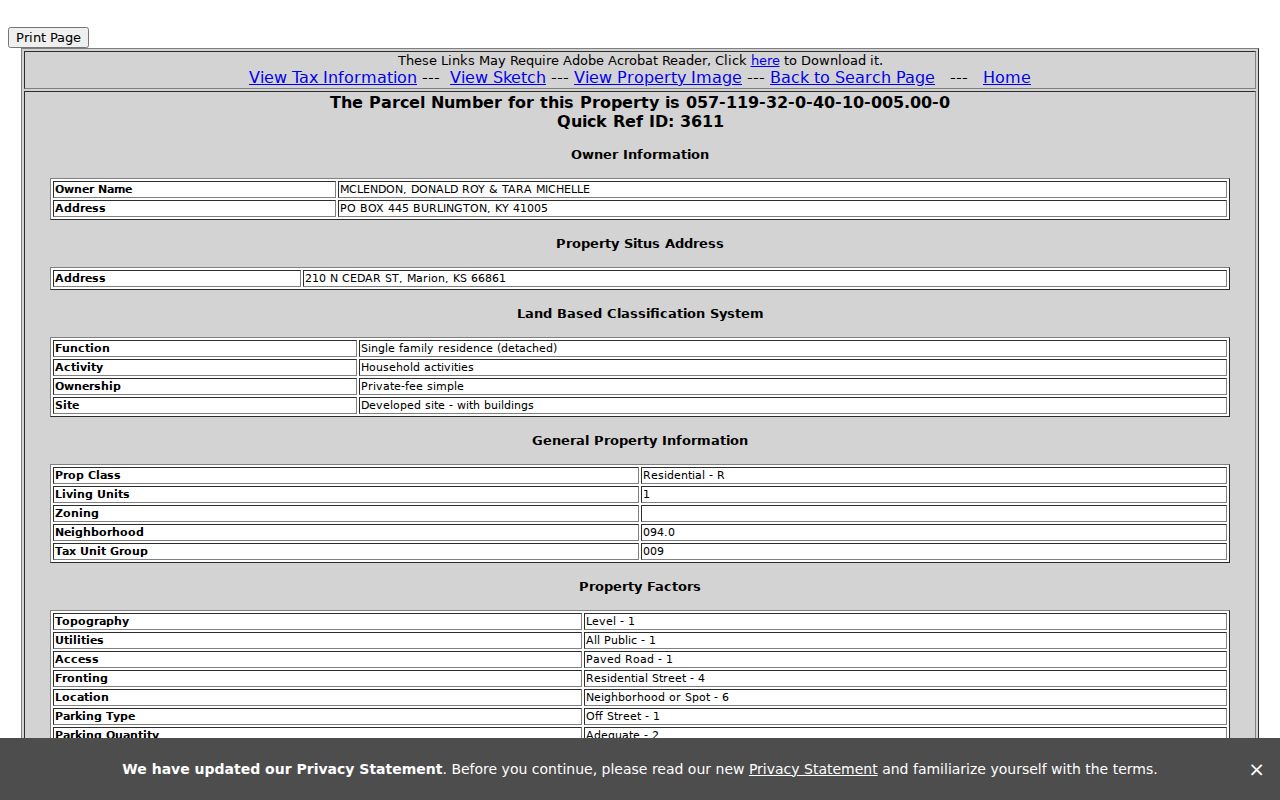
A saved value only makes sense with its year attached. The parcel card lists the tax year, so label every figure you keep with that year.
Apply Kansas Rates to Marion County Assessed Value
The Kansas Department of Revenue valuation formula moves from appraised value to assessed value, then applies the mill levy to produce the tax. Assessment is statutory math. It is not a second guess at market price.
| Property class | Kansas assessment basis | Reading tip |
|---|---|---|
| Residential | 11.5% of appraised value | Confirm Residential-R on the parcel card |
| Vacant lot | 12% of appraised value | Do not apply the home rate merely because the lot is in town |
| Commercial or industrial | 25% of appraised value | Verify actual classification for the tax year |
| Agricultural land | 30% of use value | Use value follows a separate productivity method |
Agricultural value works differently. It comes from an eight-year moving average with delayed inputs. Treat it as its own thing. Don't stack it against the price of development land or a residential appraisal.
Note: Classification and tax year belong in every Marion County property value note. The same percentage does not apply to every parcel.
Look Up a Marion County Property Value
Start with the parcel card. Keep the property identity fixed while you move into tax or deed records, because a full parcel number and legal description prevent same-address and shortened-tax-ID mistakes.
- Accept the public disclaimer and search the situs address, owner, full Parcel ID, or Quick Ref ID.
- Open the detailed result and record class, tax year, land value, building value, and total appraised value.
- Open the county tax detail and match its tax ID, legal description, and assessment year to the same parcel.
- Ask the Register of Deeds about the recorded instrument if a transaction price or consideration is needed.
- Appraised value
- The appraiser's estimate of fair market value for most real property, with agricultural land treated by use.
- Assessed value
- The class-adjusted amount used as the tax base.
- Assessment ratio
- The statutory percentage applied to the class, such as 11.5 percent for residential real property.
- Sale consideration
- The amount stated in a conveyance when the recorded document makes it available.
January Appraisal and Marion County Reinspection
Kansas law sets the appraisal date for real property on January 1 every year. The County Appraiser works to that schedule. Each parcel must also be physically reinspected at least once every six years. Under Marion County's 2026 plan, roughly 17 percent of real property gets a field review annually. The named areas in that rotation include Goessel, Burns, Tampa, Peabody Township, Doyle, Logan, Risley, and Gale.
An improvement detail can shift after a field review even if no deed was ever recorded. That is why an appraisal event is not the same thing as a sale event. Two update schedules also exist side by side. The parcel-search page refreshes its results every Sunday. The county Mapping page reports the DASC appraisal database updating every two weeks.
Keep Marion County Tax Figures in Their Layer
The Marion County Tax Search returns six fields. Assessed valuation, mill levy, ad valorem tax, special assessments, total paid, and delinquency status all appear. Those fields trace how assessed value becomes a bill. The bill is not evidence of market price.
One 2025 detail shows the arithmetic. Assessed value was $14,747. A 206.175 mill levy produced $2,867.96 in ad valorem tax. It added $125 in specials, for a $2,992.96 total. That single record shows the layers, not a rate another parcel should borrow. For deadlines, protests, and exemptions, use the dedicated property-tax records page.
The sample tax detail shows year-by-year rows.
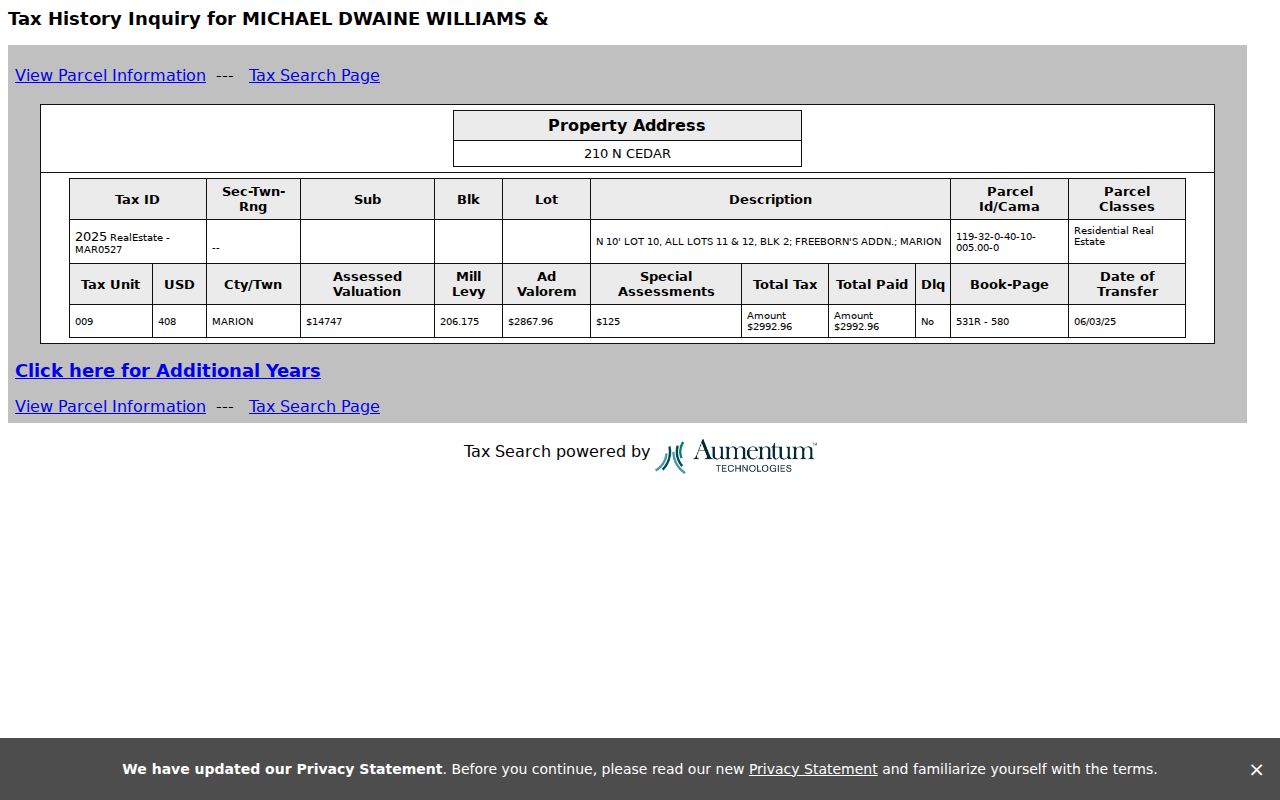
One title did not match. The tax detail's owner name differed from the parcel-card owner field, so match the parcel number and legal description rather than trusting a single heading.
Recorded Sale Price Is Separate From Appraisal
The parcel card carries no sale-price field. A deed book and page reference is only a lead. Ask the Marion County Register of Deeds whether consideration is visible on the deed and what copy route applies.
An appraisal estimates value for a tax date. The two answer different questions. Family transfers, estate instruments, quitclaim deeds, and non-arm's-length deals may not offer a useful market comparison. Never derive a sale amount from assessed value.
Keep a Dated Marion County Value Log
Build the log with columns first. Record the source, tax year, parcel number, property class, and value type beside every figure you write down. That discipline matters here. The Marion County parcel card can list several appraisal years, the Treasurer detail carries the assessed valuation plus tax amounts, and a deed may add a transaction amount from an entirely different date. Pile those numbers into one unlabeled column and you lose the reason they disagree.
Keep the legal description as your identity check. A situs address gets abbreviated, and a tax heading can carry an older owner of record. If a building value jumps, compare the card's improvement facts and the relevant city permit file before calling the increase a sale trend. A dated log keeps the comparison reproducible.
Note one more thing. When you compare two years, check whether the property class and parcel configuration also stayed the same.
City Programs Can Explain Marion County Value Changes
City files often hold the explanation. An improvement or special charge may appear on the Marion County tax bill. It may trace back to a municipal program. Marion's Neighborhood Revitalization Program requires contact before construction. It also requires a building permit and county appraiser eligibility review. The application fee is $25 and nonrefundable. Eligible properties may earn a ten-year tax rebate. Petition street improvements work differently. They place a cost on the tax roll for ten years with interest.
Treat these as parcel-specific leads, never assumptions. Match the city application and permit to the county appraisal year. Then check the tax detail before drawing conclusions. Peabody's land-use map should be dated before you rely on it. Hillsboro's zoning map needs verification too. The digital map warns that recent lot changes may be missing.
What Marion County Property Value Cannot Prove
Every Marion County property value comes from an annual public valuation system. It proves no sale price. It settles no title, sets no boundary, and never replaces a parcel-specific appraisal. Timing also bends the numbers. A remodel may not appear until after inspection. And a fresh deed can reach the recorder before the appraisal roll catches up.
Value is not price. A Marion County assessed value serves taxation and does not predict what a property will sell for or replace an appraisal.