
Trace Marion County Former Owners
Marion County publishes no online recorder index. That limits things, but not badly. Deed work starts with parcel-card leads at the Register of Deeds, and the Kansas Historical Society finding aid supplies archival depth, though its year spans describe microfilm holdings rather than online coverage.
| Source | Years It Covers | Where Held | What It Shows |
|---|---|---|---|
| Deed indexes | 1870 to 2000 | KSHS microfilm finding aid | Name, volume/page, and land clues |
| Deed records | 1870 to 1928 | KSHS microfilm; county originals as applicable | Recorded conveyance text |
| Mortgage records | 1875 to 1930 | KSHS microfilm | Mortgages, parties, land, and releases |
| Probate wills | 1868 to 1927 | KSHS holdings | Estate and heir leads requiring deed confirmation |
| County atlases | 1885, 1902, 1921, 1928, 1971 | KSHS catalog and local collections | Period owners, farms, roads, and townships |
Start from the newest deed you know. Move backward one grantor at a time. When the office index, a book reference, or a date points into microfilm, shift the search to the archive. Each grantor becomes the next prior-owner lead. Each linked deed adds one verified name to the sequence of previous owners.
Build the chain by instrument, not by piling up loose names. An atlas, tax roll, city directory, obituary, or newspaper story can hint at who held land in a given year. None of that counts until a recorded description and deed tie the person to the parcel. Keep everything in date order. Hold that order even as you jump between record sets.
Overlap between sources is a gift. A microfilm index may supply the volume and page. The county office may hold the original or a later continuation. Write down which copy you read. Note whether you saw the instrument itself or only an index entry. That habit keeps a list of prior owners from sounding more certain than the evidence behind it. It also flags which owners still need an instrument check.
Walk Marion County Deeds Backward
A current deed names two parties. The grantee received the interest; the grantor conveyed it. That grantor is your next past owner, so keep the legal description fixed while you chase the name, since street names and numbers can change over the years.
- Copy the current parcel's deed book/page leads and full legal description.
- Retrieve the newest deed and record its grantor, grantee, date, and description.
- Search the grantor as an earlier grantee, checking initials, spouses, and fiduciary roles.
- Repeat one verified instrument at a time, then shift to deed books or microfilm.
- Grantor
- The party conveying a stated interest.
- Grantee
- The party receiving that interest.
- Chain of title
- The ordered succession of instruments affecting ownership.
- Reverse index
- An index organized to help find conveyances through the grantee side.
- Quitclaim deed
- A deed conveying whatever interest the grantor has without warranty of title.
Anchor Marion Owners to Land
Legal descriptions outlast street addresses. Marion parcel records show why that matters. Two similarly numbered Cedar Street addresses carried lot-and-block descriptions in the Freeborn and Southern Addition. A Peabody tract paired section, township, and range with boundary calls from Central Avenue and Maple Street.
Copy every call exactly. A surname alone can mislead. Without matching land, it may point to a different parcel entirely, while the full description also helps office staff pull plats, tract books, mortgages, and releases.
Open Marion County Archive Records
The KSHS Marion County finding aid lists deeds, mortgages, probate material, case files, dockets, and indexes. Tract books skip names entirely. They run by legal description. That helps when only the land is known. The state archive's Marion County holdings page displays those historical series and their date spans.
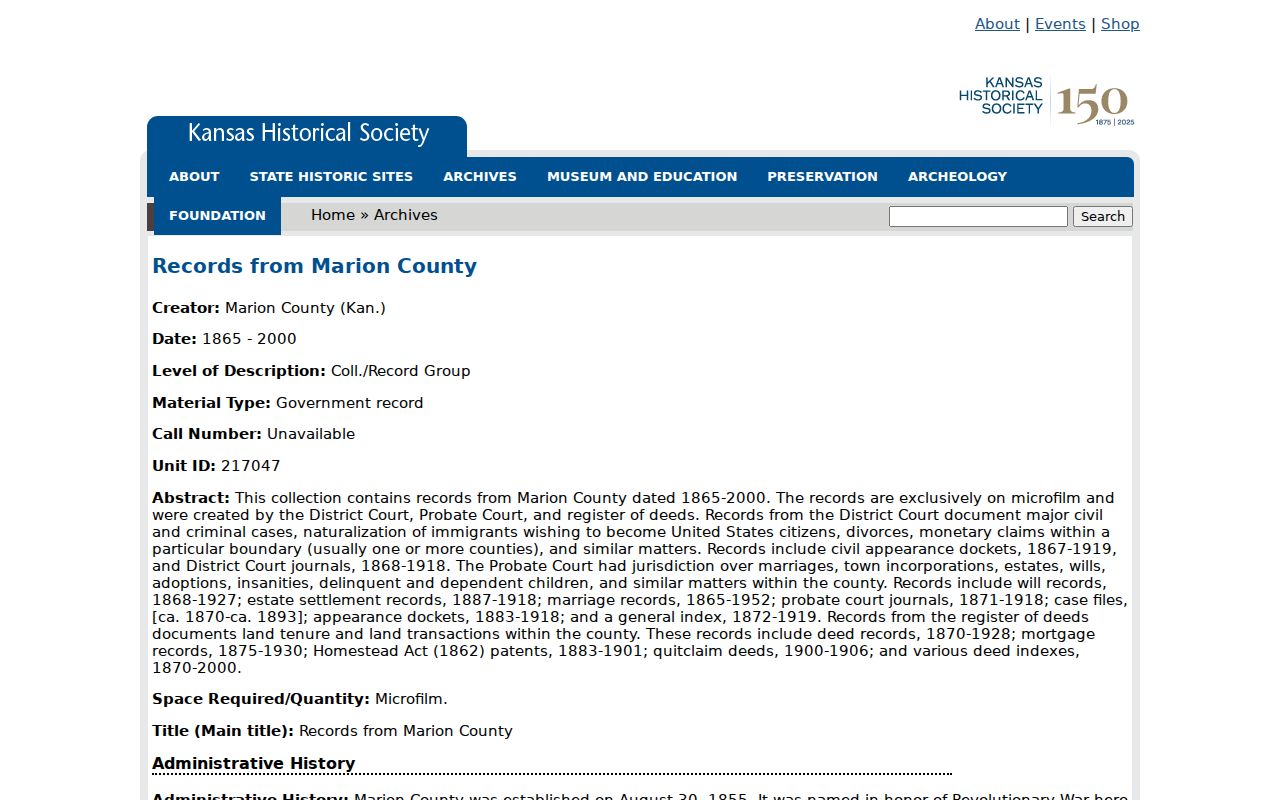
Pick your route before requesting a reel. Each series answers a different question.
A deed index may list grantor, grantee, volume and page, township, section, lot, addition, or file number. Mortgage indexes sometimes add acreage and release details. Order the reel and volume matching your date and record type, then verify the entry against the actual instrument.
Archive cutoff. The confirmed deed-index run is 1870 through 2000. This is archival coverage, not a claim that those years are searchable online.
Follow Marion County Estate Transfers
Death interrupts a tidy buyer-seller sequence. Start at the Marion District Court. Look for a probate petition, will, inventory, sale order, final settlement, or personal representative, then move to the recorder for an executor or administrator deed, survivorship instrument, transfer-on-death deed, or land affidavit.
Estate files hide names. Try married names, initials, trustees, and executor labels. A will proves an estate plan, but it cannot replace the recorded conveyance that completes the parcel's chain. Mortgage releases and tax claims often ran through the estate too.
Search Former Marion Place Names
Old place names hide former owners. Marion's post office began as Marion Centre. The postal name dropped "Centre" in 1881, and the city followed in 1882. Deed indexes, directories, and newspapers kept that older spelling.
Search both forms for city property. Then use the addition and lot description to bridge the old record into the current parcel. That dated variant beats assuming every early reference used today's city name.
Map Former Marion County Owners
The KSHS property-map catalog holds several county atlases. The 1971 Tri-Tabula volume pairs township maps with an alphabetical rural directory. An atlas can tie a former owner to a road, farm, stream, or township when no useful address ever existed.
Atlas dates matter, though. A printed owner is only a clue. It shows who held land that year, not current title, so translate the location into a legal description, find the county deed, and continue the chain in recorded instruments.
Test Marion Owner Newspaper Leads
Peabody's digitized newspaper archive carries long runs. It holds the Gazette, the Gazette-Herald, and the Gazette Bulletin. Legal notices moved land fast in print. Estate sales, transfer reports, and probate notices sometimes surface a name. They can beat any film index to it. Search the party name and also a distinct phrase pulled from the legal land description.
Treat every newspaper hit as a lead, never a record. Confirm reported transfers with the Register of Deeds. Take tax disputes to the Treasurer. Probate or court orders go to the District Court. Write down the paper's title, date, and page. That citation lets anyone retrace the find later.
Request Marion County Deed Books
Start with the Marion County Register of Deeds, the custodian of the recorded chain. The office sits at 200 S Third Street, Suite 105, in Marion. Reach staff at 620-382-2151 or rod@marioncoks.net. When you call, have the legal description ready. Bring party name variants, estimated dates, and any book and page leads you hold. Ask which courthouse index or volume continues past the KSHS microfilm run.
The office does not conduct title research or guarantee results. So define each record yourself. Request one indexed instrument at a time. Keep a working timeline that flags gaps, name changes, and shifts in the land description.
Copy charges and filing fees are separate things. Marion County lists copy-to-email at fifty cents per page. Fax copies run two dollars per page. Confirm the current copy cost, certification option, and accepted payment method before ordering anything. Court-copy fees and deed filing rates do not apply to a recorder copy request.
Audit Marion County Title Gaps
A tidy list of former owners can still hide a gap. Lay each deed beside the next. Compare recording dates, execution dates, grantor, grantee, deed type, book and page. Compare the full land description too. Then hunt between transfers for quitclaim deeds, mortgage releases, lis pendens notices, and court orders.
An index entry may simply be misspelled. Try variants, initials, married names, corporations, trustees, executors, and administrators. When the parcel is certain but the name is not, move to a tract book. A chain holds only if each instrument links the same described parcel to the next.
Measure Marion Ownership Record Depth
Marion County was established in 1855. It was organized in 1865. Its final boundary came in 1872. The archival deed series starts later than county establishment. Probate wills reach back to 1868. Homestead Act patent material sits in the KSHS record group. It spans 1883 through 1901 and may supply federal land-origin evidence.
A manuscript loss at the Marion City Library is not a county deed loss. Each gap belongs to its own keeper. Before concluding a Marion County record is truly gone, ask the recorder about original books and courthouse access.
Lawful use. Former-owner records support house history and land research. Never use historical or current address information to track, harass, or harm a person.