
Find Who Owns Marion Property
The public Marion County Parcel Search is the fastest way to find an owner of record. Type in the street number and name. Add the ZIP if the address is a common one. Directional prefixes matter here. The same house number can appear on both North Cedar and South Cedar, for instance. A short address alone may not pinpoint the parcel you want.
- Search the complete situs address and open every plausible result.
- Copy Owner Name, mailing address, full APN, Quick Ref ID, and legal description.
- Match the APN and description against tax and map records.
- Ask the Register of Deeds for the latest conveyance tied to the parties and land.
Treat the appraisal owner as a lead, never a title opinion. Recent deeds, probate transfers, and corrections can sit unrecorded on the roll for a while. Whenever you report who owns the tract, state the source and its date.
Keep a dated note of each result. Record the displayed tax year and whether the Primary owner filter was on. When several parcels carry one name, list each APN separately. That way an owner is never carried from tract to tract.
Ownership fields get crowded, too. One parcel can hold multiple owners or several deed references, so preserve every indexed party. Search spouses and joint owners independently. A name's spelling can shift between the assessor roll and a recorded deed.
Locate Marion County Ownership Evidence
No single screen settles every ownership question. Marion County spreads the trail across appraisal, recording, tax, and map systems, each holding a different piece of the evidence.
| Source | Owner Info It Gives | Access |
|---|---|---|
| Appraiser parcel card | Owner Name, mailing address, situs, APN | Public after disclaimer |
| Register of Deeds | Grantor, grantee, deed, legal description | Office, phone, or email request |
| Kansas business search | Entity record and resident agent | Public online search |
| ORKA parcel map | Mapped parcel and appraisal context | Public viewer |
The Owner Name field stands apart from the Property Situs Address and the mailing address. A post-office box or distant mailing address tells you nothing about who occupies the land.
Property traits offer a second identity check. The detailed roll may list acreage, class, neighborhood, dwelling style, year built, and improvements. This helps when two similar addresses surface. Matching those details strengthens your parcel identification. Even so, appraisal facts still cannot prove the named party holds good title.
Read Marion County Owner Fields
A detailed parcel result can show class, neighborhood, tax-unit group, and annual values. It can also show improvements, deed references, and a tract description. One sample card listed an out-of-state post-office box beside the Marion situs. That context helps with contact, not occupancy.
The official Marion County parcel card places the Owner Name beside the parcel identifiers. The land description sits right there too.
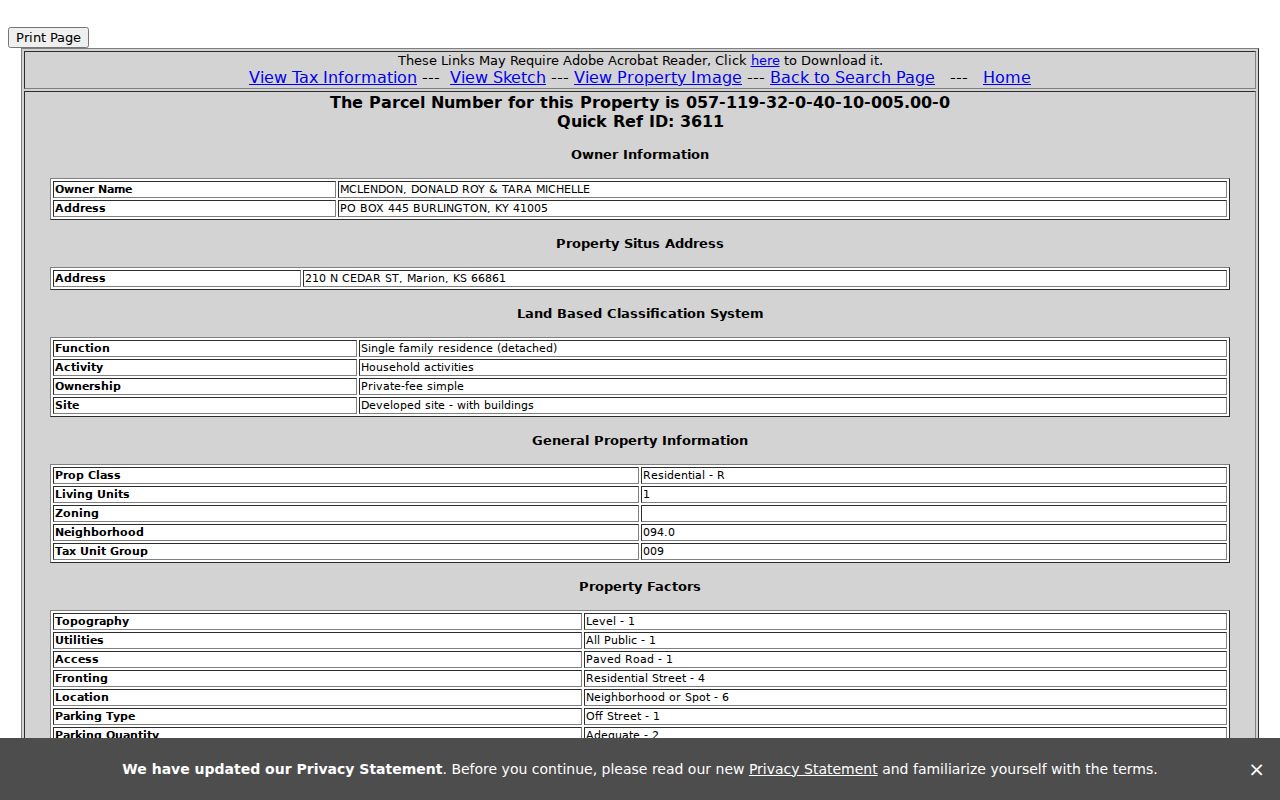
The layout points to the method. Copy the owner name exactly, then carry the APN and legal description with it into the deed check.
- Owner of record
- The name carried on the current government roll or recorded instrument.
- Grantee
- The party receiving an interest in a deed.
- Situs
- The physical location of the taxed parcel.
- Title
- The legal ownership interest, broader than a database name.
Confirm Who Owns Marion Property
The Marion County Register of Deeds publishes no online grantor-grantee index. Bring the office the exact owner name, the APN, the complete legal description, and any book or page leads from the parcel card. Request the newest deed affecting the tract and confirm who owns the described land.
Recording alone cannot clear every title question. Mortgages, releases, easements, probate papers, court orders, and correction deeds may all bear on ownership. The office itself states that it performs no title research and guarantees no results.
Owner names are leads. A roll name is not a title search, and ownership may rest in an LLC, trust, estate, or joint interest.
Resolve Marion County Owner Conflicts
One mismatch shows the risk plainly. A detailed parcel card carried one Owner Name while its linked tax-detail title showed another. Both screens shared the same situs and parcel route. That gap proved no second owner or transfer. It proved a tax header cannot stand alone when you decide who owns the parcel.
Compare the parcel and CAMA numbers, tax ID, situs, legal description, transfer date, and deed reference. If any key differs, identify the right tract first. For a recent sale, request the newest recorded deed before trusting the owner result.
Research Marion County Entity Owners
An owner field can name an LLC or a trust. It may instead list an estate, a surviving spouse, or joint owners. Search each party exactly as indexed. The Kansas business entity search can surface an entity record and its resident agent. An agent is not automatically the beneficial owner of the property.
Estates add steps. You may need the Marion District Court probate docket and an order. A later executor or administrator deed may follow. A trust name does not entitle anyone to beneficiary details. Tie every ownership conclusion to a public source and a date.
Check Marion County Owner Timing
Timing shapes every answer. The parcel search updates every Sunday, and County Mapping says its DASC appraisal database refreshes every two weeks. The tax roll is set September 1. A later buyer may need to contact the Treasurer about the tax bill. The county publishes no average deed-to-roll lag.
Note the date of each search you run. Compare the latest deed date with the roll year and the map refresh, then ask the responsible office whether a change has been processed. A mismatch usually reflects timing, not misconduct. Always date any answer about who owns the property.
Request Marion County Owner Proof
Disagreements between public screens call for the source office. Contact the Register of Deeds at 200 S Third Street, Suite 105, Marion. You can also call 620-382-2151. The office also publishes rod@marioncoks.net. Give staff the exact party spellings, the full APN, the situs, and the legal description. Include every book and page reference from the parcel card. Ask whether the newest instrument has been indexed. Ask too whether a courthouse index is open for public use.
Fees follow the county's filing and copy schedule. A first-page deed filing is listed at $21, with each additional page at $17. Those are filing rates, not copy prices. Copy-to-email runs fifty cents per page, and fax copies cost two dollars per page. Confirm the current amount and payment method before ordering.
Uncertainty from a court-ordered transfer, foreclosure, quiet title action, or partition points to the Kansas District Court Public Access portal. An estate dispute points there too. Request the actual file from the Marion clerk. A judgment can direct a transfer. Still, the land record must show the resulting recorded instrument.
Need an administrative record outside a specialist office? Send a written Kansas Open Records Act request to the County Clerk. The county guide says the agency will respond or make contact within three business days. It can also explain why more time is needed. KORA does not require an office to give a title opinion.
Broaden a Marion Owner Search
An exact owner search that fails is not the end. Try the surname alone, initials, spouse names, and the displayed capitalization or order. The parcel form includes a Primary checkbox. It narrows results to a primary owner. A broad first pass, though, helps expose jointly held parcels. Inspect every candidate. Never assume all hits belong to one person.
Rural land responds to the section, township, and range controls. The form also permits filters such as property class, neighborhood code, acreage, and appraised amount. Treat these as narrowing aids only. None substitutes for matching the APN and legal description.
With only a parcel number in hand, enter the complete 27-character ID. A partial value may return several properties. The six-character Quick Ref ID belongs in its own field. Do not confuse it with an R-prefixed number.
Use Marion Tax Records Carefully
The Treasurer search accepts a last name or company name, Tax ID, tax year, and split address fields. Its year selector reaches from 2025 back to 1987. A tax result can show assessed valuation, mill levy, special assessments, total tax, payment, and delinquency status. It can also show the legal description and a transfer reference.
Those details help confirm the same parcel was found. They do not make the tax bill a deed. A bill recipient or a stale title line does not establish current title. A paid-tax record does not either. Route the ownership conclusion back to the parcel Owner Name and the newest recorded conveyance.
Remember the division of labor. The Treasurer collects and distributes taxes. The Appraiser maintains valuation data. The Register of Deeds records instruments. Asking the right office prevents a tax question from becoming an unsupported title claim.
Set Marion Owner Search Limits
An ownership lookup can connect a parcel to an indexed owner, mailing address, and situs. It can also surface deed leads. It cannot prove who lives there, reveal unrecorded agreements, or replace title work. Kansas Safe at Home participants may use substitute addresses. A visible mailing address is never permission to seek a protected residence.
Lawful use. Use Marion County owner records for legitimate property diligence. Never use names or addresses to stalk, harass, or target anyone.