
Read Marion County's Current Owner
The parcel card calls the appraisal-roll party "Owner Name." A mailing address sits right beside it. The situs address gets its own line, while other fields tie the owner of record to the correct piece of Marion County land.
| Owner Name | Person, joint parties, estate, trust, or entity carried on the roll |
|---|---|
| Mailing Address | Destination used for owner notices, not proof of residence |
| Property Situs | Physical location of the taxable land |
| Parcel and Quick Ref | Keys used to match appraisal, tax, and map records |
| Legal Description | Lot, block, addition, or tract language identifying land |
| Deed Reference | Book/page leads for recorder confirmation |
The official Marion County parcel card shows the owner field alongside the situs, mailing address, and parcel keys. It is a good model of what to expect.
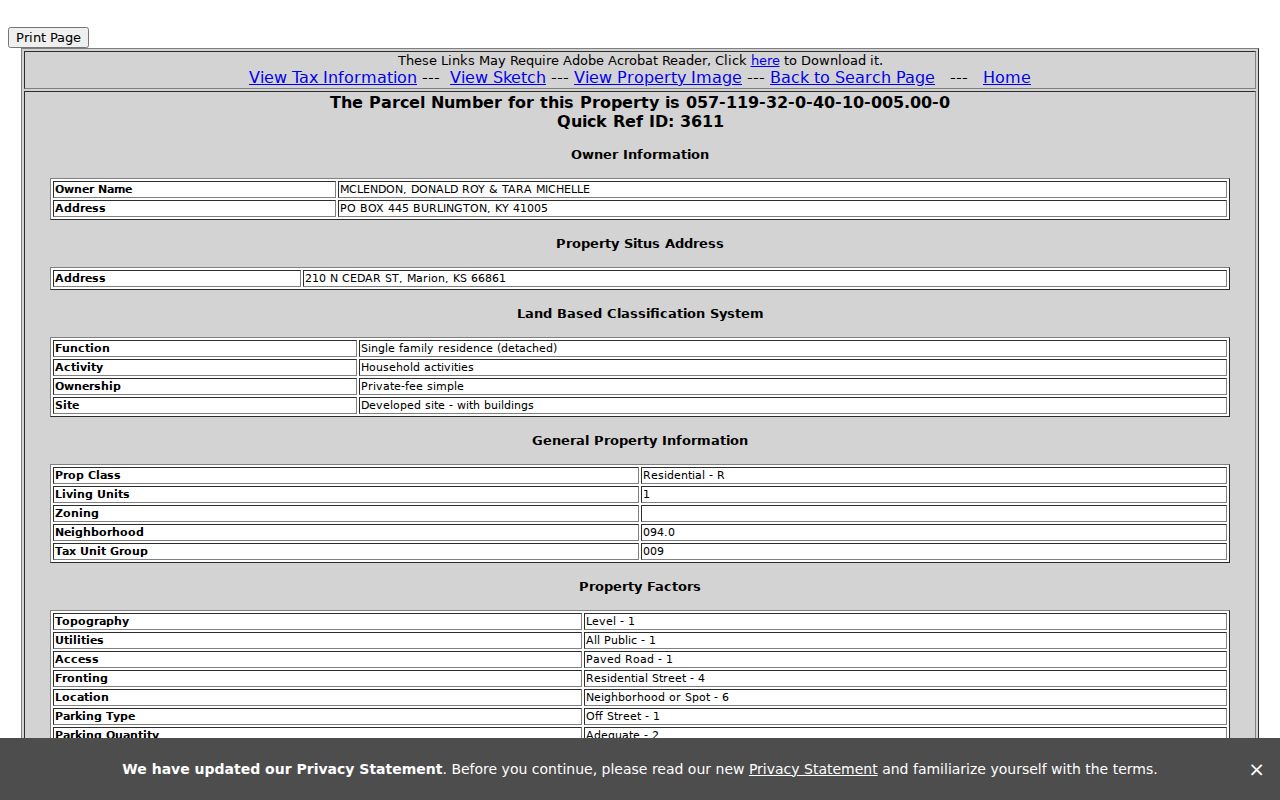
Read the Owner Name as a dated roll entry and carry the APN and legal description into the newest-deed confirmation.
The Marion sample placed the owner mailing address outside Kansas while the situs remained in Marion. That did not identify an occupant. It showed why each address must retain its label.
The same card may show several deed references. Their order on an appraisal screen is not a guaranteed chain. Use recording dates and the legal description to decide which instrument is current. If the parcel was split or combined, ask the Appraiser how the present APN relates to the older land record.
Value changes also do not prove a sale. Marion County appraises real property as of January 1 each year, and field reinspection can update building traits without a conveyance. Only a matching recorded instrument supports a transfer conclusion.
A current owner check should therefore preserve both the parcel snapshot and recorder response. Date each item, identify its custodian, and note any unresolved difference. This record trail supports a clear conclusion without overstating what one public screen establishes.
Confirm Marion County's Current Owner
Start with the Marion County parcel search and note the date on the live result. Take those identifiers to the recorder next. The county publishes no online recorder index, so confirmation takes an office, phone, or email request.
- Match Owner Name to the full situs, APN, and legal description.
- Give the Register of Deeds all names and book/page references on the parcel card.
- Ask for the newest deed affecting the exact description and inspect its grantee.
- Check later corrections, probate instruments, or court-ordered transfers when relevant.
- Owner of record
- The party shown by a specified current public record.
- Assessment roll
- The county's valuation list, which is not a title report.
- Recording lag
- Time between acceptance of a deed and updates in another system.
- Vesting
- The manner in which the deed states that an interest is held.
Time Marion County Owner Updates
The parcel-search form says "Updated every Sunday." That is one of two published schedules. The County Mapping page says the DASC appraisal database refreshes every two weeks. Neither gives the lag from closing to owner change. The annual tax roll is set September 1. Buy later than that, and the statement may take a call to the Treasurer. Record the search date, the displayed tax year, and the newest deed's recording date. Then compare all three.
Recent sale check. The roll can lag a transfer. The newest recorded deed is the more current ownership source when the parcel identity matches.
Audit Marion County Owner Conflicts
Marion County's own records supply a useful test. One parcel card's Owner Name differed from the linked tax-detail page's title, though both screens followed the same situs and parcel route. That mismatch proves no new conveyance. A tax-page title can be stale or mismatched. To audit the match, line up the parcel and CAMA number, tax ID, legal description, book and page, and transfer date. Never swap the appraiser's current owner field for a tax heading unless the deed and identifiers back that up. The deed decides.
Separate Marion Owner Addresses
The situs shows where the taxable land lies. The mailing address shows where the owner record sends correspondence. That can be a post-office box, an out-of-state home, a tax agent, or another delivery point. Neither address reveals who sleeps there. For lawful property mail, copy the address exactly as published and keep the context limited. Kansas Safe at Home supplies substitute addresses for qualifying protected participants. A substitute address never invites a residence hunt.
Interpret Marion County Entity Owners
Marion County's owner of record may be an LLC, a trust, or an estate. Several names can appear at once. Preserve punctuation and order. The Kansas Secretary of State entity search can confirm a corporation or LLC and its resident agent, but it does not cover every trust, sole proprietorship, assumed name, or beneficial interest. Estates take one more step. Search the Marion District Court probate record, then confirm the executor, administrator, survivorship, or transfer-on-death instrument with the Register of Deeds. Ownership rests on the land record, not a guess.
Match Marion Current Owner Keys
A solid owner conclusion needs three land keys at once. Those keys are the full APN, legal description, and situs. Add the tax ID and deed book and page when available. Names collide easily. A partial parcel-number search can return several Marion County results. The county sample carried an APN beginning with the Kansas prefix 057 plus a separate six-character Quick Ref ID; keep those fields distinct. If the deed description and parcel description disagree, ask the Appraiser or the recorder about a split, combination, or indexing change.
Request a Marion Current Deed
The Register of Deeds sits at 200 S Third Street, Suite 105, in Marion. Office hours run 8 a.m. to 5 p.m. on weekdays. Staff take calls at 620-382-2151 and email at rod@marioncoks.net. Marion County publishes no online grantor-grantee search. So confirming the present owner of record takes extra effort. Expect a counter visit, a phone call, or an email to the recorder's office.
Request the most recent deed indexed to the exact tract. A surname search alone is not enough. Give staff the current and prior party names. Also provide the parcel number, the full legal description, and any deed book and page references you hold. Ask whether a correction deed, a release, a probate instrument, or a court filing follows the apparent purchase deed. Those instruments can change who holds title.
The office does not conduct title research. It does not guarantee results either. That limit matters most in complex cases. Think joint interests, an entity, an estate, or a contested transfer. A title professional can examine the full chain of deed records and their exceptions. That step fits whenever the answer supports a legal or financial act involving the land.
Inspect Marion Current Parcel Details
A Marion County parcel card carries far more than a name. It may list property class, living units, zoning where populated, neighborhood, tax-unit group, topography, utility and road factors, annual land and building values, dwelling traits, and detached improvements. Those details help separate parcels that share an owner name or a street number.
Treat book and page references on the card as leads. Copy every one. Then ask the office which instrument is latest and which describes the same land. A blank zoning field does not mean zoning is absent. A linked photo or sketch proves neither title nor boundary.
Keep the displayed tax year on any result. One sampled parcel showed a newer appraisal year than the tax portal's selector offered, showing how connected county systems can present different effective periods.
Protect Marion Owner Information
Kansas public-record access has limits. The Safe at Home program lets qualifying survivors use a substitute address. Protected family members get the same shield, and it applies across many records. A published owner-mailing field may therefore be a valid official contact address. It works without exposing where anyone lives.
Never merge parcel data with restricted voter, motor-vehicle, or confidential records. The Kansas Open Records Act permits exemptions and privacy redactions. Keep a Marion County owner lookup tied to the parcel question itself. Disclose no more personal information than the public land record actually establishes.
Use Marion Owner Records Lawfully
The current owner field supports property diligence, tax research, deed confirmation, and boundary questions. It does not verify an occupant or authorize intrusive contact. Sensitive identifiers stay off the parcel card, and protected material remains governed by Kansas law.
Lawful use. Public owner information may support a legitimate property matter. Never use it to stalk, harass, intimidate, or expose a protected person.