
Marion County Deed Types
Each instrument in Marion County deed records names the parties and describes the land. It also gives a recording reference and states its type as presented to the Register of Deeds. The type carries real weight. A warranty deed and a quitclaim deed make very different promises about title. An executor or trustee instrument signals that the authority to sell comes from an estate, a trust, or a court process. That is different from a simple owner signing.
| Deed Type | What It Does | Common Use |
|---|---|---|
| Warranty deed | Conveys the stated estate with deed warranties | Ordinary sale or conveyance |
| Quitclaim deed | Transfers whatever interest the grantor holds | Interest cleanup or family transfer |
| Trustee or executor deed | Conveys under stated fiduciary authority | Trust or estate transaction |
| Sheriff or tax deed | Records a transfer after the required sale process | Foreclosure or delinquent-tax case |
| Plat | Creates or identifies lots, blocks, and dedications | Subdivision and land identity |
A deed conveys an interest. A mortgage or lien burdens one. A later recorded release clears that specific filing. Always search both sides of the transaction and read every instrument itself. Remember that a payoff statement alone is never a recorded release.
Follow Marion County Grantors
Marion County publishes no official online grantor-grantee interface for deed records. Start instead with the current parcel card, then ask the Register of Deeds to search the current grantee, the prior grantor, the legal description, and any known book and page. Running each name in reverse order builds the chain one link at a time.
- Use the parcel card's owner, legal description, and deed references to locate the newest likely conveyance.
- Read the grantee and grantor exactly as indexed, including initials, joint names, trust titles, or estate roles.
- Search the grantor as an earlier grantee, then match the same land description before adding that deed to the chain.
- Check mortgages, releases, liens, lis pendens, and relevant court orders alongside each ownership step.
- Move to KSHS microfilm and older books when the working index no longer reaches the needed year.
- Grantor
- The party transferring the stated interest.
- Grantee
- The party receiving the stated interest.
- Chain of title
- The ordered series of instruments linking ownership over time.
- Book and page
- A recorder reference used to retrieve a particular instrument.
Record every link in date order and keep the source reference with it. If the legal description shifts, pause and find out whether a split, combination, correction, or new plat explains the change.
Marion County Deed Depth
The Kansas Historical Society Marion County finding aid lists deed records from 1870 through 1928 and deed indexes spanning 1870 to 2000. Mortgage records run from 1875 through 1930. Separate holdings include quitclaim deeds from 1900 through 1906. Those dates describe archival microfilm held by the state, not a searchable web portal.
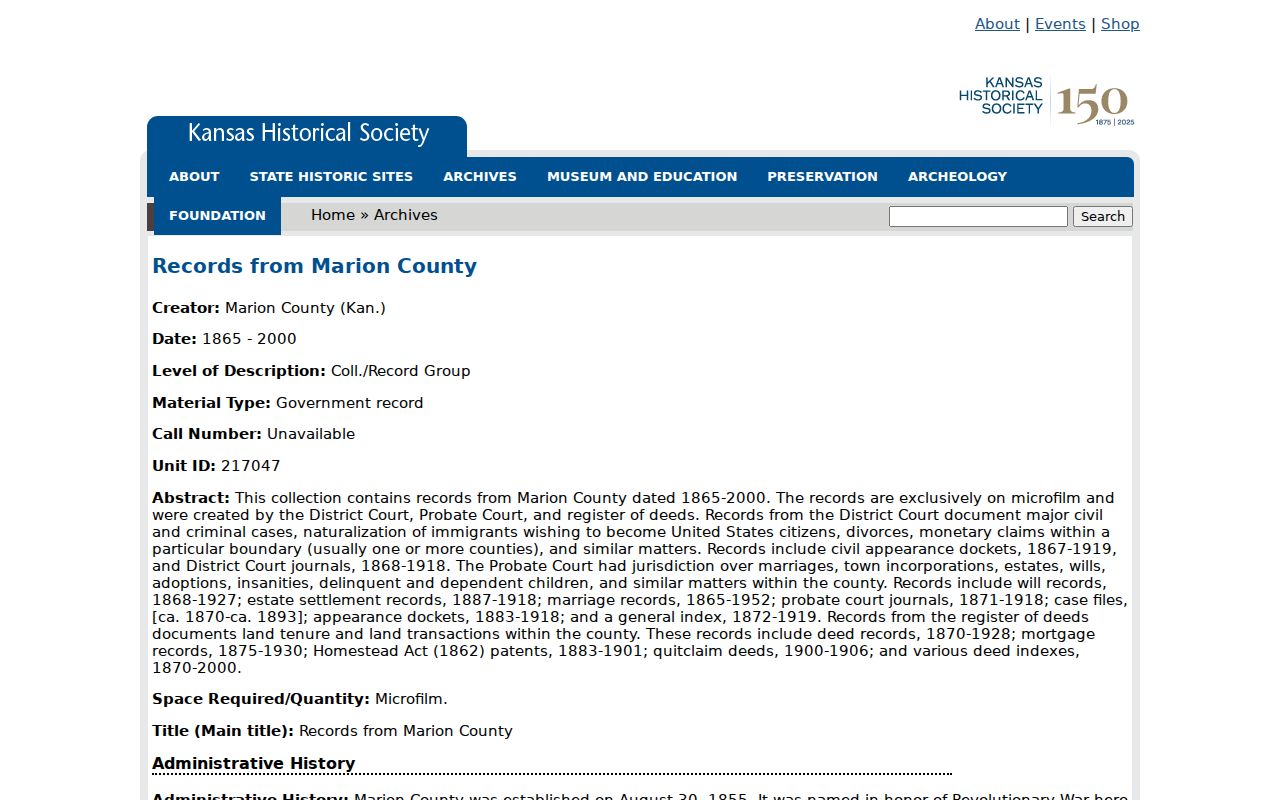
The finding aid names the archival runs. It points older deed research toward the state collection. It offers no online deed search results, only the microfilm inventory itself.
County atlases from 1885, 1902, 1921, 1928, and 1971 can deepen an older search. An atlas often supplies a historical name and a township clue. The deed index and legal description must then connect that clue to the modern parcel. An atlas name alone never proves present title.
Land Descriptions Anchor Deeds
Street names change. Rural tracts may never have carried a useful address. A postal city can differ from the land-use jurisdiction, too. Marion County deed records avoid all of that confusion. They stay tied to the legal description. City land usually turns on addition, lot, and block. Rural land leans on section, township, range, quarter, and metes-and-bounds calls.
Carry the wording exactly as written. The sample parcel at 210 N Cedar reads Freeborn, north ten feet of Lot 10 and all Lots 11 and 12, Block 2, at plat book/page 1/25A. That full description works far better as a recorder request key. Cedar Street never could.
Search Marion County Deed Books
Search historical indexes from more than one direction. Begin with the most recent confirmed deed. Copy the grantee, grantor, book and page, date, instrument type, and legal description. Then search that grantor as an earlier grantee. Repeat only after the land description matches. A same-name hit on different land belongs to no chain. One index line never captures every clause in the recorded deed.
Name variants matter throughout Marion County deed records. Try initials, full given names, married names, spelling variants, and corporate names. Also try roles such as trustee, executor, administrator, or surviving spouse. For an estate transfer, the probate docket can reveal the authority or order. The recorder holds the actual land instrument. For a mortgage, search borrower and lender roles and hunt for the later assignment or release.
Tract books and some indexes organize land by legal description rather than owner. General deed indexes can carry town or township, section, survey, lot, addition, and subdivision. They may also carry volume and page and file number. Mortgage indexes may add acreage and a release date. Preserve the exact labels used in each volume, since a modern APN never appears in an early book. When the trail reaches KSHS microfilm, cite the collection plus the reel or volume. Then another researcher can repeat the step.
Marion County Recorded Burdens
Deeds are only part of the recorder's holdings. Mortgages, releases, assignments, and liens sit in the same index. So do easements, covenants, lis pendens, and plats. A deed chain can look clean and still hide a burden. Search owner names on both sides. Match each result to the land.
A lis pendens should be traced to its District Court case and final result. A mortgage should be paired with any later release or assignment. The Kansas SOS UCC system is separate. It is no substitute for the land-record index.
Ask for the original filing and its later disposition. A release must match by parties, recording reference, and legal description. An assignment may change the party entitled to release a mortgage. Easements and restrictive covenants can continue until an amendment, vacation, expiration term, or other recorded act changes them. The newest deed alone will not expose those instruments.
Court Orders Need Recording
Court files often explain why a deed exists. Foreclosure, quiet title, partition, probate, and lien cases all leave their mark. Kansas CaseSearch can supply case information. The courthouse kiosk or a written request may reach documents the web does not show. Even a confirmation order does not prove the final conveyance was recorded.
Check the court outcome against the Register of Deeds. In a judicial tax foreclosure, the current owner holds title until court confirmation. Trace the later deed as its own instrument.
The Marion County District Court Clerk sits at 200 S Third Street, Marion. Weekday public hours run 8 a.m. to 5 p.m. A useful request names the case number, filing date, parties, and document sought. Ask for the petition, judgment, final order, confirmation, or deed exhibit. Then compare names and land terms with the recorder entry.
Request Marion County Deed Copies
Contact the Marion County Register of Deeds at 200 S Third Street, Suite 105, Marion, KS 66861, 620-382-2151, or rod@marioncoks.net. The listed counter hours are Monday through Friday, 8 a.m. to 5 p.m. No official online image viewer was found, so ask whether the needed deed can be supplied at the counter, by email, or by another office method.
The published schedule lists $21 for the first page of a deed, mortgage, or other writing and $17 for each added page. Certification is $13, email copies are $0.50 per page, and fax copies are $2 per page. A town plat is listed at $32 per page. Confirm the current charge and payment method before ordering; the office page says cash or check.
Recorded, not guaranteed. The office states that it “does not do Title Research nor Guarantee Results.” Marion County deed records must not be presented as a title opinion.
No County Fraud Alert Found
The county publishes no property-fraud alert signup. That gap should not be filled by a private service posing as official. Owners can still check the parcel roll. Save the current deed reference, and contact the recorder about any unfamiliar instrument.
Local deed roundups can offer a lead. The recorded instrument still controls. A newspaper summary may use an appraisal address or shorthand that misses parties, exceptions, or legal-description terms.